

In this article, I’ll explain how to book cheap hotels using a simple trick to get great discounts. We’ll compare two of the most popular online booking options and analyse their advantages, as well as why there’s such a big difference in price. By the end of the article, you’ll have a clear idea of which website is best for booking a hotel.
I’ll admit it, I too have spent hours browsing websites trying to find the one with the best hotel price. Perhaps I’ve been lured by the myths claiming there are sites offering beachfront hotels for the price of a sandwich. The thing is, I’ve never actually found these sites and always end up booking through the same reservation sites.
Like me, many people stick to what they know and end up booking where they always do, and Booking and the hotel’s own website are two of the people’s favourite options. Booking claims to offer the best hotel discounts and attracts a huge number of travellers, but is it always the best option? Let’s find out.
Booking or the hotel’s own website
Booking is the undisputed leader in Europe and always offers competitive prices compared to other booking websites. It’s an excellent option for searching by destination thanks to its huge variety of accommodation, and the tools it offers allow for very precise searches. What’s more, it has the Genius loyalty programme, which gives access to significant discounts at certain properties. For all these reasons, and given its track record, Booking.com is a very popular, efficient and secure option for making bookings.
However, once you’ve chosen your accommodation, the hotel’s own website usually offers better deals than any other site. In fact, simply by comparing the hotel’s own website with Booking, you can get a discount of up to 15 per cent on your hotel stay. This discount can be even greater if you compare the hotel’s website with other booking sites.
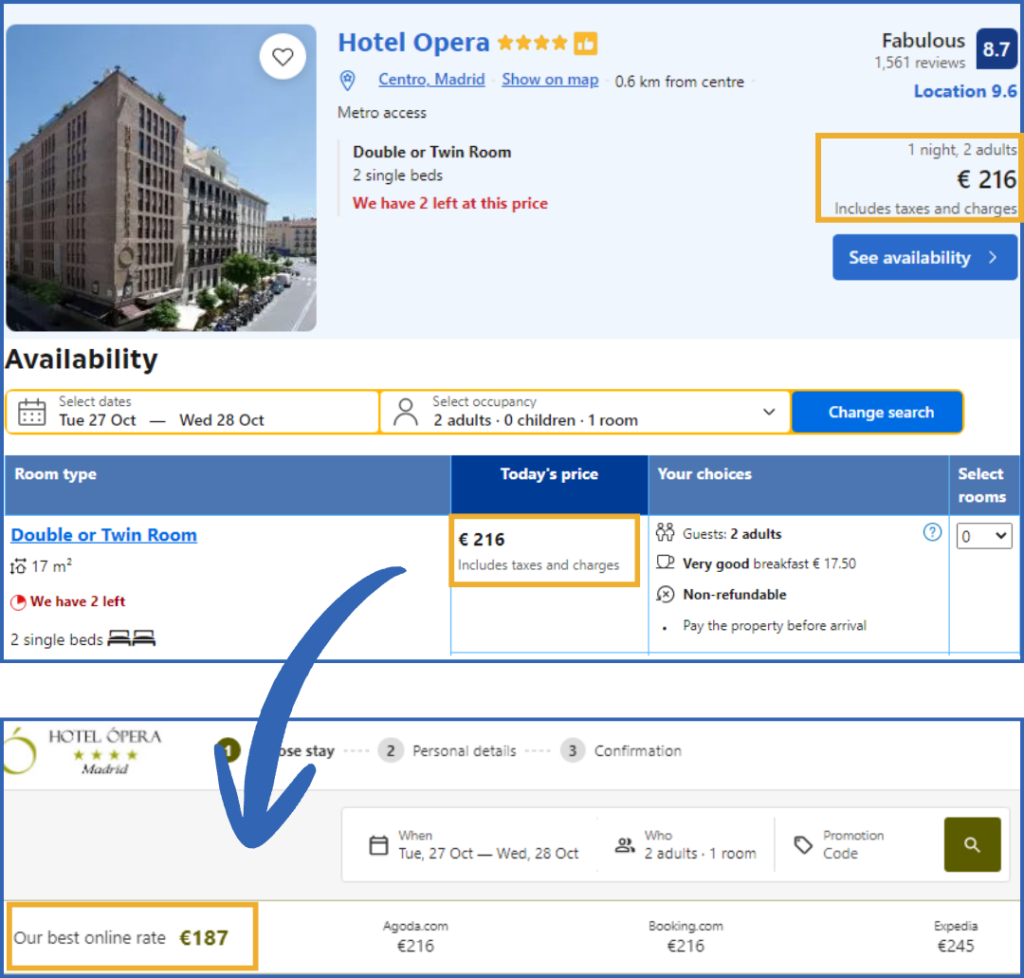
This isn’t always the case, nor is the discount percentage always the same, but generally speaking, the best price is found on the hotel’s own website. The price difference can be so significant that it’s well worth taking the time to make the comparison.
Why it’s cheaper to book on the hotel’s own website
The price difference stems from ‘distribution costs’, that is, the commission that booking portals take for acting as intermediaries. Let’s explain this:
Booking takes a commission of between 10% and 25% of the total cost of each booking made via its website (there are exceptions, which we’ll discuss later). A very common commission rate is 15%. Another popular booking portal is Expedia, which typically charges a commission of between 17% and 18%.
Let’s say a hotel has agreed a 15 per cent commission with Booking, and we make a reservation for €120 (excluding VAT). €18 will go directly to Booking, and the remaining €102 to the hotel. Therefore, for this hotel, selling via its own website for €102 brings in the same revenue as selling via Booking for €120.
This hotel could take its strategy a step further and set a price of €110 on its website, offering an attractive €10 discount compared to Booking whilst, at the same time, earning more money than it would through the intermediary.
“Booking takes a commission of between 10% and 25% of the total cost of each booking made via its website”
For accommodation providers, it is very important not to rely too heavily on intermediaries, and this is one of the reasons for offering better terms via their own website and attracting direct bookings.
Other advantages of booking via the hotel’s website
Saving up to 15 per cent on the hotel rate is undoubtedly reason enough to at least have a look at the hotel’s website. However, there are other benefits we could take advantage of and which we should bear in mind.
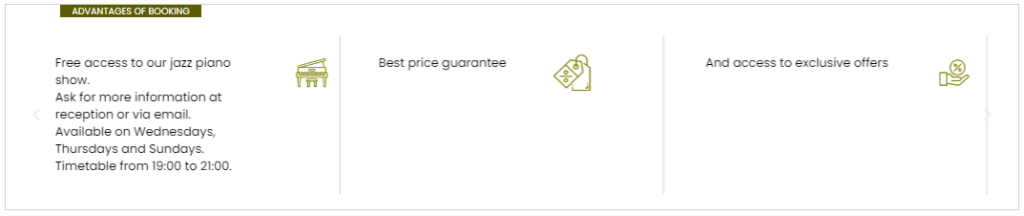
Some hotels choose not to offer any discounts on their own website, instead trying to attract direct bookings with other perks. Other hotels that do offer discounts on their website also encourage direct bookings by providing small perks for guests.
The most common benefits of booking via the website are usually better cancellation terms and small discounts on hotel services, such as room service, the restaurant, the spa, car park, etc. However, some hotels go a step further and offer free breakfast, free car park, early check-in and late check-out at no extra cost, welcome drinks and free access to areas or services within the hotel that would otherwise incur a charge.
In addition to all this, in my experience, it is very important to be able to manage the booking directly with the hotel. When booking through an intermediary, any changes must be made via the booking platform; the hotel does not have full control.
Should any problem arise and you need to amend or cancel your booking, it’s always easier to call the hotel and sort it out. If you need to ask for a favour (such as changing dates after the deadline, for example), they’re likely to be more understanding if you’ve booked directly with them.
Exceptions
Although many establishments offer better rates via their own website, this is not the case for all hotels. Some accommodation providers maintain the same price on their website as on Booking, or even offer better rates through intermediaries. There are various reasons for this:
Discounts on intermediary sites
Sometimes booking websites offer discounts, either through their loyalty programs or to the general public. In order to offer discounts, intermediaries reduce their commission rate and offer lower (and more competitive) prices at the cost of receiving less commission income. This can mean that prices on intermediaries’ sites are the same as on the hotel’s own website, or that they are even lower on intermediaries’ sites.
Small establishments
There are very small accommodation providers that do not have their own booking website or have not developed it sufficiently for it to be a source of direct bookings. In these cases, it is common for Booking or other intermediaries to be their main source of bookings and the platform where their best rates are published.
Strategy
Some properties consider certain customers to be more valuable than others. As a result, they may offer better rates via specific booking websites to boost sales amongst a particular customer profile.
The concept of price parity
Until a few years ago, there was a school of thought in the hotel industry that justified charging the same price across all sales channels (the property’s own website and intermediaries) so as not to compromise the customer experience. This approach has gradually faded away, but some still adhere to it. Price parity can be found for this reason.
Conclusion
We’ve seen that although Booking is an excellent website for searching for and booking accommodation, the lowest price is often found on the hotel’s own website. Furthermore, direct bookings can give us access to benefits which, although they may seem minor, can make all the difference.
So, where should you book? Searching on Booking.com and comparing the price with the hotel’s own website is a simple, quick and very effective way to find the best deals without driving yourself mad. After comparing, simply choose the most suitable option.
We could sum up this article by saying that if you’re looking for the best website to book cheap hotels, that website will most likely be the one run by the hotel you choose.